Call:
lm(formula = y ~ x, data = sim_dat)
Residuals:
Min 1Q Median 3Q Max
-2.75568 -0.67016 0.01042 0.63073 2.73709
Coefficients:
Estimate Std. Error t value Pr(>|t|)
(Intercept) -0.0004678 0.0452219 -0.01 0.992
x 0.6960271 0.0465049 14.97 <2e-16 ***
---
Signif. codes: 0 '***' 0.001 '**' 0.01 '*' 0.05 '.' 0.1 ' ' 1
Residual standard error: 1.011 on 498 degrees of freedom
Multiple R-squared: 0.3103, Adjusted R-squared: 0.3089
F-statistic: 224 on 1 and 498 DF, p-value: < 2.2e-16The Linear Regression Estimator and Matrix Algebra
Estimation, Model Fit, and Matrix Algebra
Guidance for Midterm Exam
- All material (lectures, readings, examples, etc.) are fair game for the exam.
- I do not expect you to entirely reproduce proofs of theorems, but I expect you to recognize and understand the key ideas and be able to apply them.
- You may be asked to elaborate on particular points and provide additional context or examples.
- This may entail working through particular characteristics of the estimator – e.g., demonstrate the unbiasedness of the OLS estimator.
Guidance for Midterm Exam
- Key terms and concepts: Normal equations, OLS estimator, Gauss-Markov theorem, OLS estimator, OLS residuals, etc.
- Conceptual applications are common (e.g., what are the assumptions of the Gauss-Markov theorem? What does it tell us about the OLS estimator? How does it help us understand the OLS estimator?)
- Interpretation is also important (e.g., what does the OLS estimator tell us about the relationship between \(X\) and \(Y\)?)
Example
Gauss-Markov Assumptions. If the PRF is written as: \(Y_i=\alpha+\beta X_i+\epsilon_i\), and the SRF is expressed as: \(Y_i=a+b X_i+e_i\).
What assumptions are required in order for the OLS estimator to be the best linear unbiased estimator with minimum variance? Describe each assumption in no more than 1-2 sentences.
The Gauss-Markov theorem holds that if these assumptions are met, the OLS estimator of \(b\) is a linear function of \(y_i\) (i.e., \(b=\sum k_i Y_i\)). Please demonstrate this.
The Gauss-Markov theorem holds that if these assumptions are met, the OLS estimator is an unbiased estimator of \(\beta\). Please demonstrate this (hint: use \(b=\sum k_i Y_i\) to show this is the case).
Part I: Estimation in R
The Data Generating Process (DGP)
The DGP is the underlying process that produces the sample data we observe — the PRF that generates the data.
Its the mechanism – we assume – generated the observed data + sampling error.
We can simulate data from a known DGP to understand how sampling, estimation, and inference work together.
Using a function in R
simulate_regression_data <- function(
  n = 500, beta_0 = 0, beta_1 = 0.2,
  x_mean = 0, x_sd = 1, error_sd = 1
) {
  X <- rnorm(n, mean = x_mean, sd = x_sd)
  errors <- rnorm(n, mean = 0, sd = error_sd)
  Y <- beta_0 + beta_1 * X + errors
  data.frame(x = X, y = Y, true_y = beta_0 + beta_1 * X, error = errors)
}
PRF vs. SRF: Visualizing the DGP
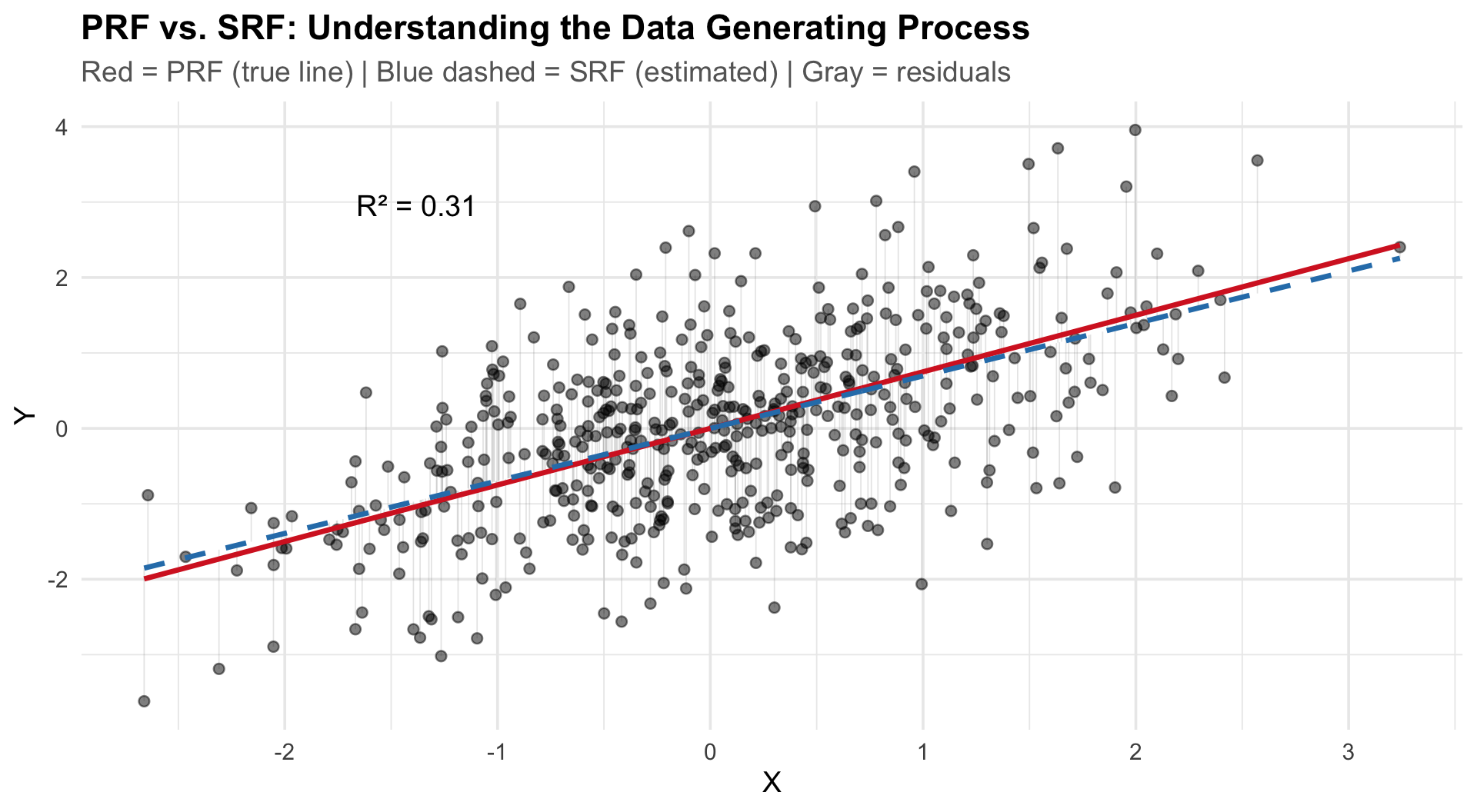
Key elements of the plot:
- PRF (red solid): \(Y_i = \alpha + \beta X_i + \epsilon_i\) — the true line we never see
- SRF (blue dashed): \(Y_i = a + bX_i + e_i\) — our estimate from the sample
- Residuals (gray): \(e_i = Y_i - \hat{Y}_i\)
The SRF approximates the PRF. How well depends on:
- Sample size \(n\)
- Error variance \(\sigma^2_\epsilon\)
- Variance of \(X\)
Estimation with lm()
Estimation with lm()
Key elements of the output:
| Element | Meaning |
|---|---|
| Coefficients | Estimated \(a\), \(b\) with SEs, t-values, p-values |
| Residual SE | Average distance of observations from the regression line |
| \(R^2\) | Proportion of variance in \(Y\) explained by \(X\) |
| F-statistic | Tests whether the model beats the null (\(\bar{Y}\)) |
Generating Predictions
        1
0.6955593 1 2 3
0.1735390 0.2083404 0.2431417 1 2 3 4 5 6
-0.39057401 -0.16067754 1.08443545 0.04860798 0.08952000 1.19326394 Predictions are just \(\hat{Y}_i = a + bX_i\) evaluated at chosen \(X\) values.
Part II: Model Fit
Model Fit: \(R^2\), Correlation, & ANOVA
The correlation \(r\) equals the standardized slope in bivariate regression:
Regression Estimates
Call:
lm(formula = scale(y) ~ scale(x), data = sim_dat)

Residuals:
     Min       1Q   Median       3Q      Max
-2.26700 -0.55132  0.00857  0.51888  2.25170

Coefficients:
             Estimate Std. Error t value Pr(>|t|)
(Intercept) 3.351e-17  3.718e-02    0.00        1
scale(x)    5.570e-01  3.722e-02   14.97   <2e-16 ***
---
Signif. codes:  0 '***' 0.001 '**' 0.01 '*' 0.05 '.' 0.1 ' ' 1

Residual standard error: 0.8313 on 498 degrees of freedom
Multiple R-squared:  0.3103,    Adjusted R-squared:  0.3089
F-statistic:   224 on 1 and 498 DF,  p-value: < 2.2e-16
[1] 0.5570035\(b_{x} \approx 0.557\)
Correlation Estimates
[1] 0.5570035\(r_{xy} \approx 0.557\)
Key relationships:
- \(R^2 = r^2\) in bivariate regression
- \(r = \sqrt{R^2} \times \text{sign}(\beta)\)
- The correlation is the standardized regression coefficient
Decomposing the Variance (ANOVA)
\[TSS = RegSS + RSS\]
\[\sum(Y_i - \bar{Y})^2 = \sum(\hat{Y}_i - \bar{Y})^2 + \sum(Y_i - \hat{Y}_i)^2\]
| Component | Formula | Meaning |
|---|---|---|
| TSS | \(\sum(Y_i - \bar{Y})^2\) | Total variation in \(Y\) |
| RegSS | \(\sum(\hat{Y}_i - \bar{Y})^2\) | Variation explained by the model |
| RSS | \(\sum(Y_i - \hat{Y}_i)^2\) | Unexplained (residual) variation |
\(R^2\): The Coefficient of Determination
\[R^2 = \frac{RegSS}{TSS} = 1 - \frac{RSS}{TSS}\]
- \(R^2 = 0\): model explains nothing; \(E(Y|X) = \bar{Y}\)
- \(R^2 = 1\): deterministic relationship; all points on the line
Proportional reduction in error — how much better is our model than just predicting \(\bar{Y}\)?
The F-statistic
\[F = \frac{RegSS / df_{reg}}{RSS / df_{res}} = \frac{MSS_{reg}}{MSS_{res}}\]
Where \(df_{reg} = k\) and \(df_{res} = n - k - 1\).
Hypotheses:
- \(H_0\): \(\beta = 0\) (model no better than null)
- \(H_a\): \(\beta \neq 0\) (model explains variance)
The F-statistic is a ratio of two variances — it follows the F-distribution under \(H_0\).
What Happens When You Vary Parameters?
Increase error (\(\sigma_\epsilon\)):
- Points scatter more around PRF
- \(R^2\) drops
- Sampling distribution of \(b\) widens
- But \(b\) remains unbiased
Increase \(\sigma_X\):
- More spread in \(X\) → more leverage
- \(R^2\) increases
- \(var(b)\) decreases — more efficient
Increase \(n\):
- SRF → PRF
- Standard errors shrink \(\propto 1/\sqrt{n}\)
- \(R^2\) stabilizes
Set \(\beta = 0\):
- SRF still estimates some slope (sampling error)
- Monte Carlo distribution centers on zero
- This is the null hypothesis in action
Characteristics of the OLS Estimator
Part II: Matrix Algebra
Vectors, Matrices, and the OLS Estimator
Why Matrix Algebra?
- Writing the SRF in matrix form makes it easier to solve
- Quantitative social science aims to quantify relationships between multiple variables
- Data is tabular: rows = observations, columns = variables
- We need tools to solve systems of equations efficiently
\[\begin{bmatrix} y_{1}= & b_0+ b_1 x_{1}+b_2 x_{2}\\ y_{2}= & b_0+ b_1 x_{1}+b_2 x_{2}\\ \vdots\\ y_{n}= & b_0+ b_1 x_{1}+b_2 x_{2} \end{bmatrix}\]
- \(n\) equations, fewer unknowns — linear algebra gives us the solution
Data as a Matrix
Each row is an observation; each column is a variable.
\[\begin{bmatrix} Vote & PID & Ideology \\\hline a_{11} & a_{12} & a_{13} \\ a_{21} & a_{22} & a_{23} \\ \vdots & \vdots & \vdots\\ a_{n1} & a_{n2} & a_{n3} \end{bmatrix}\]
- This is an \(n \times 3\) matrix
- First subscript = row, second = column
- Notation: \(\mathbf{A}_{n \times 3}\)
Vectors: The Building Blocks
- Scalar: a single number (magnitude only)
- Vector: multiple elements — encodes magnitude and direction
A vector \(\mathbf{a} \in \mathbb{R}^k\) has \(k\) elements.
The Norm of a Vector
The norm measures the length (magnitude) of a vector from the origin:
\[\|\mathbf{a}\| = \sqrt{x_1^2 + y_1^2}\]
- Dividing a vector by its norm gives a unit vector (length = 1)
- Useful for standardization
[1] 3.741657[1] 0.8017837 0.5345225 0.2672612In higher dimensions (\(\mathbb{R}^3\)):
\[\|\mathbf{a}\| = \sqrt{x_1^2 + y_1^2 + z_1^2}\]
Vector Addition & Subtraction
Element-wise operations on conformable vectors (same length):
\[\mathbf{a} + \mathbf{b} = [3+1,\; 2+1,\; 1+1] = [4, 3, 2]\]
\[\mathbf{a} - \mathbf{b} = [3-1,\; 2-1,\; 1-1] = [2, 1, 0]\]
Properties:
| Property | Statement |
|---|---|
| Commutative | \(\mathbf{a}+\mathbf{b}=\mathbf{b}+\mathbf{a}\) |
| Associative | \((\mathbf{a}+\mathbf{b})+\mathbf{c}=\mathbf{a}+(\mathbf{b}+\mathbf{c})\) |
| Distributive | \(c(\mathbf{a}+\mathbf{b})=c\mathbf{a}+c\mathbf{b}\) |
| Zero | \(\mathbf{a}+0=\mathbf{a}\) |
Vector Multiplication
- Inner (dot) product → produces a scalar (measures similarity / covariance)
- Cross product → produces a vector (orthogonal to both inputs)
- Outer product → produces a matrix
The Inner (Dot) Product
Multiply corresponding elements and sum:
\[\mathbf{a} \cdot \mathbf{b} = \sum_i a_i b_i\]
For \(\mathbf{a}=[3,2,1]\) and \(\mathbf{b}=[1,1,1]\): \(\;\; 3(1)+2(1)+1(1) = 6\)
[1] 6 [,1]
[1,] 6The inner product is a measure of covariance:
\[\text{cov}(x,y) = \frac{\text{inner product}(x-\bar{x},\; y-\bar{y})}{n-1}\]
\[r_{x,y} = \frac{\text{inner product}(x-\bar{x},\; y-\bar{y})}{\|x-\bar{x}\|\;\|y-\bar{y}\|}\]
Inner Product Rules
| Property | Statement |
|---|---|
| Commutative | \(\mathbf{a} \cdot \mathbf{b} = \mathbf{b} \cdot \mathbf{a}\) |
| Associative | \(d(\mathbf{a} \cdot \mathbf{b}) = (d\mathbf{a}) \cdot \mathbf{b}\) |
| Distributive | \(\mathbf{c} \cdot (\mathbf{a}+\mathbf{b}) = \mathbf{c}\cdot\mathbf{a} + \mathbf{c}\cdot\mathbf{b}\) |
| Zero | \(\mathbf{a} \cdot 0 = 0\) |
The Cross Product
For \(\mathbf{a}=[3,2,1]\) and \(\mathbf{b}=[1,4,7]\):
- Stack the vectors
- Calculate \(2 \times 2\) determinants
\[\mathbf{a} \times \mathbf{b} = [2(7)-4(1),\;\; 1(1)-3(7),\;\; 3(4)-2(1)] = [10, -20, 10]\]
- Result is orthogonal to both original vectors
- Useful for determinants and matrix inversion
The Outer Product
Transpose one vector, then multiply:
\[\begin{bmatrix} 3 \\ 2 \\ 1 \end{bmatrix} \begin{bmatrix} 1 & 4 & 7 \end{bmatrix} = \begin{bmatrix} 3 & 12 & 21 \\ 2 & 8 & 14 \\ 1 & 4 & 7 \end{bmatrix}\]
- Input: two vectors of length \(k\)
- Output: a \(k \times k\) matrix
Matrices
A matrix combines row or column vectors. Notation: bold uppercase (\(\mathbf{A}\)).
\[\begin{bmatrix} a_{11} & a_{12} & \cdots & a_{1n} \\ a_{21} & a_{22} & \cdots & a_{2n} \\ \vdots & \vdots & \ddots & \vdots\\ a_{n1} & a_{n2} & \cdots & a_{nn} \end{bmatrix}\]
Matrix Types
| Type | Definition |
|---|---|
| Square | Equal rows and columns |
| Symmetric | Same entries above and below the diagonal; \(\mathbf{A} = \mathbf{A}^T\) |
| Identity (\(\mathbf{I}\)) | 1s on diagonal, 0s off; \(\mathbf{AI} = \mathbf{A}\) |
| Idempotent | \(\mathbf{A}^2 = \mathbf{A}\) |
| Trace | Sum of diagonal elements: \(\text{tr}(\mathbf{I}) = n\) |
Matrix Addition & Subtraction
Matrices must be conformable (same dimensions). Add/subtract element-wise:
\[\begin{bmatrix} a_{11} & a_{12} \\ a_{21} & a_{22} \end{bmatrix} + \begin{bmatrix} b_{11} & b_{12} \\ b_{21} & b_{22} \end{bmatrix} = \begin{bmatrix} a_{11}+b_{11} & a_{12}+b_{12} \\ a_{21}+b_{21} & a_{22}+b_{22} \end{bmatrix}\]
Properties: Commutative, Associative, Distributive, Zero
Matrix Multiplication
Order matters! \(\mathbf{AB} \neq \mathbf{BA}\) in general.
Multiply \(i\)-th row by \(j\)-th column:
\[\begin{bmatrix} 1 & 3 \\ 2 & 4 \end{bmatrix} \begin{bmatrix} 3 & 5 \\ 2 & 4 \end{bmatrix} = \begin{bmatrix} 1(3)+3(2) & 1(5)+3(4) \\ 2(3)+4(2) & 2(5)+4(4) \end{bmatrix} = \begin{bmatrix} 9 & 17 \\ 14 & 26 \end{bmatrix}\]
     [,1] [,2]
[1,]    9   17
[2,]   14   26
Conformability rule: columns of first = rows of second
\[\mathbf{A}_{m \times n} \times \mathbf{B}_{n \times p} = \mathbf{C}_{m \times p}\]
Inner dimensions must match; result has outer dimensions.
The Transpose
\(\mathbf{A}^T\) swaps rows and columns. If \(\mathbf{A}\) is \(m \times n\), then \(\mathbf{A}^T\) is \(n \times m\).
\[\begin{bmatrix} 1 & 2 & 3 \\ 4 & 5 & 6 \end{bmatrix}^T = \begin{bmatrix} 1 & 4 \\ 2 & 5 \\ 3 & 6 \end{bmatrix}\]
     [,1] [,2]
[1,]    1    4
[2,]    2    5
[3,] 3 6 [,1] [,2] [,3]
[1,] 17 22 27
[2,] 22 29 36
[3,] 27 36 45Key properties:
| Property | Statement |
|---|---|
| Double transpose | \((\mathbf{A}^T)^T = \mathbf{A}\) |
| Sum | \((\mathbf{A}+\mathbf{B})^T = \mathbf{A}^T + \mathbf{B}^T\) |
| Product (reversal) | \((\mathbf{AB})^T = \mathbf{B}^T\mathbf{A}^T\) |
Why the Transpose Matters
Transposing a product reverses the order:
\[(\mathbf{ABC})^T = \mathbf{C}^T\mathbf{B}^T\mathbf{A}^T\]
Critical result: For any matrix \(\mathbf{A}\), the product \(\mathbf{A}^T\mathbf{A}\) is always:
- Square (\(n \times n\) if \(\mathbf{A}\) is \(m \times n\))
- Symmetric
This is exactly what \(\mathbf{X}^T\mathbf{X}\) produces in the normal equations.
The Determinant
The determinant is a scalar value computed from a square matrix. It’s necessary for matrix inversion (later).
For a \(2 \times 2\) matrix:
\[\det(\mathbf{A}) = \det\begin{bmatrix} a & b \\ c & d \end{bmatrix} = ad - bc\]
- If \(\det(\mathbf{A}) \neq 0\): the matrix is nonsingular (invertible)
- If \(\det(\mathbf{A}) = 0\): the matrix is singular (no inverse exists — columns are linearly dependent)
Example:
\[\det\begin{bmatrix} 4 & 7 \\ 2 & 6 \end{bmatrix} = 4(6) - 7(2) = 10 \neq 0 \;\; ✓\]
\[\det\begin{bmatrix} 2 & 4 \\ 1 & 2 \end{bmatrix} = 2(2) - 4(1) = 0 \;\; \text{(singular — row 1 = 2 × row 2)}\]
For OLS: \(\det(\mathbf{X}^T\mathbf{X}) = 0\) means perfect multicollinearity — the columns of \(\mathbf{X}\) are linearly dependent, and we cannot solve for \(\mathbf{b}\).
Matrix Inversion
For scalars: \(a \cdot a^{-1} = 1\)
For matrices: \(\mathbf{A}\mathbf{A}^{-1} = \mathbf{A}^{-1}\mathbf{A} = \mathbf{I}\)
Requirements:
- Only square matrices can have inverses
- Must be nonsingular: \(\det(\mathbf{A}) \neq 0\)
The \(2 \times 2\) Inverse
\[\mathbf{A} = \begin{bmatrix} a & b \\ c & d \end{bmatrix} \quad \Longrightarrow \quad \mathbf{A}^{-1} = \frac{1}{ad-bc}\begin{bmatrix} d & -b \\ -c & a \end{bmatrix}\]
Example:
\[\begin{bmatrix} 4 & 7 \\ 2 & 6 \end{bmatrix}^{-1} = \frac{1}{10}\begin{bmatrix} 6 & -7 \\ -2 & 4 \end{bmatrix} = \begin{bmatrix} 0.6 & -0.7 \\ -0.2 & 0.4 \end{bmatrix}\]
\[\mathbf{A}\mathbf{A}^{-1} = \begin{bmatrix} 1 & 0 \\ 0 & 1 \end{bmatrix} = \mathbf{I} \;\; ✓\]
Properties of the Inverse
| Property | Statement |
|---|---|
| Product (reversal) | \((\mathbf{AB})^{-1} = \mathbf{B}^{-1}\mathbf{A}^{-1}\) |
| Transpose | \((\mathbf{A}^T)^{-1} = (\mathbf{A}^{-1})^T\) |
| Double inverse | \((\mathbf{A}^{-1})^{-1} = \mathbf{A}\) |
| Identity | \(\mathbf{I}^{-1} = \mathbf{I}\) |
Like the transpose, inverting a product reverses the order.
Linear Regression in Matrix Form
\[\mathbf{y} = \mathbf{X}\mathbf{b} + \mathbf{e}\]
\[\mathbf{y} = \begin{bmatrix} Y_1 \\ Y_2 \\ \vdots \\ Y_n \end{bmatrix} \quad \mathbf{b} = \begin{bmatrix} b_0 \\ b_1 \\ \vdots \\ b_k \end{bmatrix}\]
\[\mathbf{X} = \begin{bmatrix} 1 & X_{11} & \cdots & X_{1k} \\ 1 & X_{21} & \cdots & X_{2k} \\ \vdots & \vdots & \ddots & \vdots \\ 1 & X_{n1} & \cdots & X_{nk} \end{bmatrix}\]
Deriving the OLS Estimator
Same Objective: Minimize the sum of squared errors. In scalar form, we minimized \(\sum e_i^2\). In matrix form:
\[\min_{\mathbf{b}}\; \mathbf{e}^T\mathbf{e} = (\mathbf{y} - \mathbf{Xb})^T(\mathbf{y} - \mathbf{Xb})\]
Expand using the distributive property of the transpose, \((\mathbf{A} - \mathbf{B})^T = \mathbf{A}^T - \mathbf{B}^T\):
\[\mathbf{e}^T\mathbf{e} = (\mathbf{y}^T - \mathbf{b}^T\mathbf{X}^T)(\mathbf{y} - \mathbf{Xb})\]
Multiply out the terms:
\[= \mathbf{y}^T\mathbf{y} - \mathbf{y}^T\mathbf{Xb} - \mathbf{b}^T\mathbf{X}^T\mathbf{y} + \mathbf{b}^T\mathbf{X}^T\mathbf{X}\mathbf{b}\]
The middle two terms are both scalars (a \(1 \times 1\) result), and a scalar equals its own transpose: \(\mathbf{y}^T\mathbf{Xb} = (\mathbf{b}^T\mathbf{X}^T\mathbf{y})^T = \mathbf{b}^T\mathbf{X}^T\mathbf{y}\). So they combine:
\[\mathbf{e}^T\mathbf{e} = \mathbf{y}^T\mathbf{y} - 2\mathbf{b}^T\mathbf{X}^T\mathbf{y} + \mathbf{b}^T\mathbf{X}^T\mathbf{X}\mathbf{b}\]
Taking the Derivative: What Does It Mean?
In scalar calculus, \(\frac{d}{db} f(b)\) gives a single number. In matrix calculus, \(\frac{\partial f}{\partial \mathbf{b}}\) gives a vector of partial derivatives — one for each element of \(\mathbf{b}\).
If \(\mathbf{b} = [b_0, b_1, \ldots, b_k]^T\), then:
\[\frac{\partial f}{\partial \mathbf{b}} = \begin{bmatrix} \frac{\partial f}{\partial b_0} \\ \frac{\partial f}{\partial b_1} \\ \vdots \\ \frac{\partial f}{\partial b_k} \end{bmatrix}\]
This vector of partial derivatives is the gradient — it points in the direction of steepest ascent. Setting it to \(\mathbf{0}\) means every partial derivative equals zero simultaneously.
The Jacobian
The Jacobian generalizes the derivative to vector-valued functions. If a function maps \(k\) inputs to \(m\) outputs, the Jacobian is the \(m \times k\) matrix of all partial derivatives:
\[\mathbf{J} = \begin{bmatrix} \frac{\partial f_1}{\partial b_0} & \frac{\partial f_1}{\partial b_1} & \cdots & \frac{\partial f_1}{\partial b_k} \\ \frac{\partial f_2}{\partial b_0} & \frac{\partial f_2}{\partial b_1} & \cdots & \frac{\partial f_2}{\partial b_k} \\ \vdots & \vdots & \ddots & \vdots \\ \frac{\partial f_m}{\partial b_0} & \frac{\partial f_m}{\partial b_1} & \cdots & \frac{\partial f_m}{\partial b_k} \end{bmatrix}\]
For OLS, our function \(f(\mathbf{b}) = \mathbf{e}^T\mathbf{e}\) is scalar-valued (\(m = 1\)), so the Jacobian is a single row — which is just the transpose of the gradient:
\[\mathbf{J} = \left[\frac{\partial f}{\partial b_0}, \;\frac{\partial f}{\partial b_1}, \;\ldots,\; \frac{\partial f}{\partial b_k}\right]\]
Why does this matter? In the bivariate case, we took two separate derivatives (\(\frac{\partial SSR}{\partial a}\) and \(\frac{\partial SSR}{\partial b}\)) and solved two equations. The gradient/Jacobian does the same thing — but for all \(k+1\) coefficients at once, packaged as a single matrix operation. This is why matrix notation is powerful: one equation replaces \(k+1\) equations.
Matrix Derivative Rules
We need three rules — each mirrors scalar calculus:
| Scalar Rule | Matrix Rule |
|---|---|
| \(\frac{d}{db}(c) = 0\) | \(\frac{\partial}{\partial \mathbf{b}}(\mathbf{y}^T\mathbf{y}) = \mathbf{0}\) |
| \(\frac{d}{db}(\mathbf{c}^T b) = \mathbf{c}\) | \(\frac{\partial}{\partial \mathbf{b}}(\mathbf{c}^T\mathbf{b}) = \mathbf{c}\) |
| \(\frac{d}{db}(b^2 a) = 2ab\) | \(\frac{\partial}{\partial \mathbf{b}}(\mathbf{b}^T\mathbf{A}\mathbf{b}) = 2\mathbf{A}\mathbf{b}\) (if \(\mathbf{A}\) is symmetric) |
The third rule requires \(\mathbf{A}\) to be symmetric. Since \(\mathbf{X}^T\mathbf{X}\) is always symmetric (recall: \((\mathbf{X}^T\mathbf{X})^T = \mathbf{X}^T\mathbf{X}\)), the rule applies.
Applying the Rules
Our function is: \(\;\mathbf{e}^T\mathbf{e} = \underbrace{\mathbf{y}^T\mathbf{y}}_{\text{constant}} - \underbrace{2\mathbf{b}^T\mathbf{X}^T\mathbf{y}}_{\text{linear in } \mathbf{b}} + \underbrace{\mathbf{b}^T\mathbf{X}^T\mathbf{X}\mathbf{b}}_{\text{quadratic in } \mathbf{b}}\)
Term by term:
| Term | Rule Applied | Derivative w.r.t. \(\mathbf{b}\) |
|---|---|---|
| \(\mathbf{y}^T\mathbf{y}\) | Constant → 0 | \(\mathbf{0}\) |
| \(-2\mathbf{b}^T\mathbf{X}^T\mathbf{y}\) | Linear: \(\frac{\partial}{\partial \mathbf{b}}(\mathbf{c}^T\mathbf{b}) = \mathbf{c}\), where \(\mathbf{c} = \mathbf{X}^T\mathbf{y}\) | \(-2\mathbf{X}^T\mathbf{y}\) |
| \(\mathbf{b}^T\mathbf{X}^T\mathbf{X}\mathbf{b}\) | Quadratic: \(\frac{\partial}{\partial \mathbf{b}}(\mathbf{b}^T\mathbf{A}\mathbf{b}) = 2\mathbf{A}\mathbf{b}\), where \(\mathbf{A} = \mathbf{X}^T\mathbf{X}\) | \(2\mathbf{X}^T\mathbf{X}\mathbf{b}\) |
Combining: \(\;\frac{\partial\; \mathbf{e}^T\mathbf{e}}{\partial\; \mathbf{b}} = -2\mathbf{X}^T\mathbf{y} + 2\mathbf{X}^T\mathbf{X}\mathbf{b}\)
Setting the Derivative to Zero
Combining the terms:
\[\frac{\partial\; \mathbf{e}^T\mathbf{e}}{\partial\; \mathbf{b}} = -2\mathbf{X}^T\mathbf{y} + 2\mathbf{X}^T\mathbf{X}\mathbf{b} = 0\]
Rearrange (move \(-2\mathbf{X}^T\mathbf{y}\) to the right, divide by 2):
\[\mathbf{X}^T\mathbf{X}\mathbf{b} = \mathbf{X}^T\mathbf{y}\]
These are the normal equations — the matrix version of the first-order conditions.
Solve for \(\mathbf{b}\) by multiplying both sides on the left by \((\mathbf{X}^T\mathbf{X})^{-1}\):
\[(\mathbf{X}^T\mathbf{X})^{-1}\mathbf{X}^T\mathbf{X}\mathbf{b} = (\mathbf{X}^T\mathbf{X})^{-1}\mathbf{X}^T\mathbf{y}\]
Since \((\mathbf{X}^T\mathbf{X})^{-1}\mathbf{X}^T\mathbf{X} = \mathbf{I}\) and \(\mathbf{Ib} = \mathbf{b}\):
\[\boxed{\mathbf{b} = (\mathbf{X}^T\mathbf{X})^{-1}\mathbf{X}^T\mathbf{y}}\]
This requires \(\mathbf{X}^T\mathbf{X}\) to be invertible — fails under perfect multicollinearity.
Summary
- Vectors encode magnitude and direction; the inner product measures covariance
- Matrices combine vectors; operations require conformability
- Transpose swaps rows/columns; transposing a product reverses order
- Inversion is the matrix analog of division; requires a nonsingular matrix
- The OLS estimator in matrix form: \(\mathbf{b} = (\mathbf{X}^T\mathbf{X})^{-1}\mathbf{X}^T\mathbf{y}\)
References
- Gill, Jeff. 2006. Essential Mathematics for Political and Social Research. Cambridge.
- Moore, Will and David Siegel. 2013. A Mathematics Course for Political and Social Research. Princeton.